
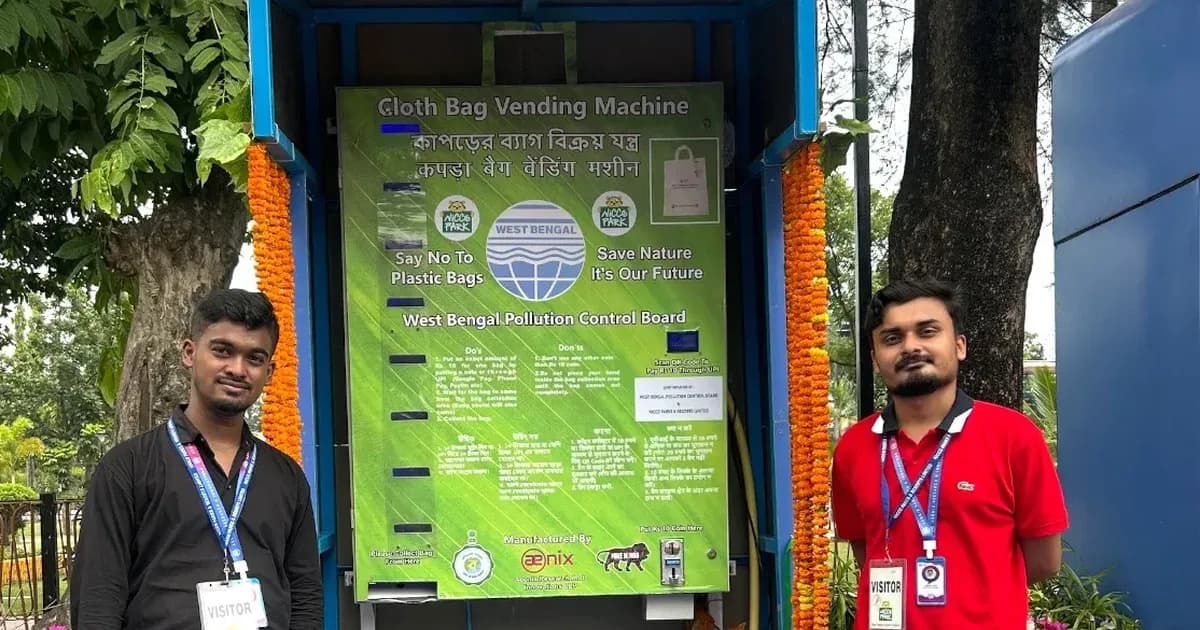
India has banned single-use plastic bags, but a ban does not help the shopper who forgot a bag at home. A cloth bag vending machine puts a reusable bag within reach at the moment someone needs one: at the market entrance, in the mall corridor, on the station platform. This guide explains how the machines work and what it takes to run one, from our experience building India's first IoT-based cloth bag vending machine with the West Bengal Pollution Control Board.
How a cloth bag vending machine works
- The shopper pays by coin or by UPI (Google Pay, PhonePe or BHIM).
- The machine releases one folded cloth bag from a spiral, the same mechanism used in snack vending machines.
- A sensor confirms that the bag actually came out, so one payment always gives one bag.
- If stock runs out or the power fails, the coin is returned automatically.
- Every sale and the remaining stock are reported to a central dashboard, which alerts the operator before the machine runs empty.
Where to place one
Put the machine where people realise they need a bag: the entrance of a market or mall, a transport hub, a temple or a public event. The machines are built for indoor and semi-outdoor sites such as covered footpaths and station platforms; fully outdoor versions with weatherproof enclosures are made on request. A visible window shows the bags inside, and a display says when the machine is out of stock.
Choosing the capacity
Our cloth bag machine comes in 50, 100 and 200-bag capacities. Size it to the footfall and to how often someone can refill it: a busy market entrance needs the larger machine, while an office lobby or a small shop does well with the smallest. Because the dashboard shows sales per machine, you can move a machine or change its capacity once you see real demand.
What it takes to run
- Power: about 60 W while dispensing, and very little when idle. A battery backup keeps it running through short power cuts.
- Bags: the main running cost is the bags themselves. The machine takes regular folded cloth bags.
- Refills: a trained operator refills it through a key-locked rear panel in under five minutes.
- Monitoring: the dashboard shows stock, transactions, payment status and uptime for every machine, so nobody has to visit a machine just to check it.
- Maintenance: minimal, with a one-year standard warranty and extended AMC available.
Who deploys them
Pollution control boards and municipalities running plastic-free campaigns, mall and market operators, large employers, religious trusts and CSR programmes. In West Bengal our machines run for the West Bengal Pollution Control Board at multiple locations, for the Animal Resources Development Department of the Government of West Bengal, at Merlin Group properties and at Nicco Park in Kolkata, and they have been installed in Salt Lake markets and in New Town. Cloth bag machines alone have dispensed more than 3 lakh bags in Kolkata.
In 2026 the machine won the Green MSME Award from the Bengal Chamber of Commerce & Industry.
Cloth bags or compostable bags?
The same platform also dispenses compostable carry bags. Cloth bags are reusable and cost more per bag; compostable bags are single-use, cost less and are certified to break down in industrial composting. Compostable material absorbs moisture, so our compostable bag machine keeps the bags in a sealed compartment with desiccant to stop them sticking together in the monsoon.
Before you buy: a short checklist
- Does it confirm each dispense with a sensor, and return coins when it cannot dispense?
- Does it take UPI as well as coins?
- Is there a dashboard with stock and sales per machine, and alerts before it runs empty?
- Is the body steel and suited to where it will stand?
- Who installs it, trains your staff and services it, and how quickly?
Prices depend on capacity, payment options and quantity, so we quote per project. Tell us where the machines will go and we will recommend the model and capacity.
See the IoT Cloth Bag Vending Machine →