
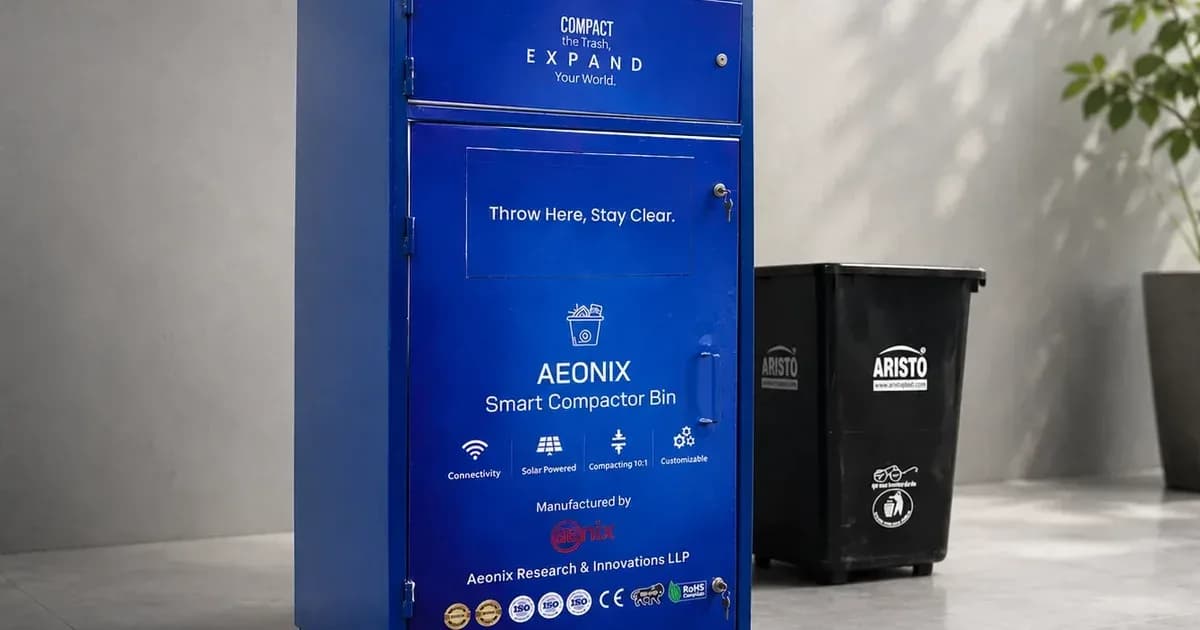
They're regular bins with a sensor stuck on top.
A real compactor bin is a different engineering problem. We just shipped ours — here's what the build actually involved.
Compaction is mechanical engineering
Motor and actuator selection took multiple iterations. Underpowered, the bin jams. Overpowered, it destroys itself in 6 months. Add jam detection, controlled retract, and — non-obvious until you build one — fire detection. Compacted trash plus heat is a real risk.
Solar in India ≠ solar on a spec sheet
Dust kills 5-15% generation per month. Monsoon weeks deliver near-zero. Lab-spec'd batteries fail within 6 months in 45°C summers. We oversized the panel ~40%, picked high-temp battery chemistry, anti-dust panel coating. Boring. Necessary.
Fill-level sensing is harder than it sounds
In a compactor, fill changes non-linearly — same trash reads differently pre and post compaction. Calibration logic has to account for compaction state, not raw distance. Otherwise the dashboard lies to the city.
Vandalism is a design parameter
The solar panel is the first target. The battery is second. Anti-theft mounts, tamper-evident screws, accelerometer-based shock detection, SMS alerts on off-schedule access. Most "smart bins" don't survive their first month without these.
The software is the final 50%
The hardware is half the product. The dashboard that drives route optimization, predictive scheduling, and fault alerts is the other half. Without that, the bin just compacts in private.
Two takeaways
- "Smart bin" is one of the most abused terms in the Indian smart city market.
- The hardest part of any IoT product isn't the sensors. It's everything around them.
More installations are rolling out this year. If you're evaluating smart bins for a city, campus or facility, we're happy to walk through what to actually look for.
See the Solar-Powered IoT Compactor Bin →
Originally published on LinkedIn. Read the comments there →