
A smart dustbin is supposed to cut collection trips and keep public spaces clean. Many products sold under that name are ordinary bins with a sensor on top. This guide covers what to check before you buy smart bins for a city, campus or facility in India, drawn from building and deploying our own solar compactor bin and e-waste bin in Kolkata.
Start with the problem you are solving
Smart bins solve different problems, and the right product depends on which one you have.
- Overflowing bins and too many collection trips: you need compaction, so the same bin holds more before it fills.
- Trucks emptying bins that are not yet full: you need fill-level sensing and a dashboard, so collection goes out only when a bin is actually full.
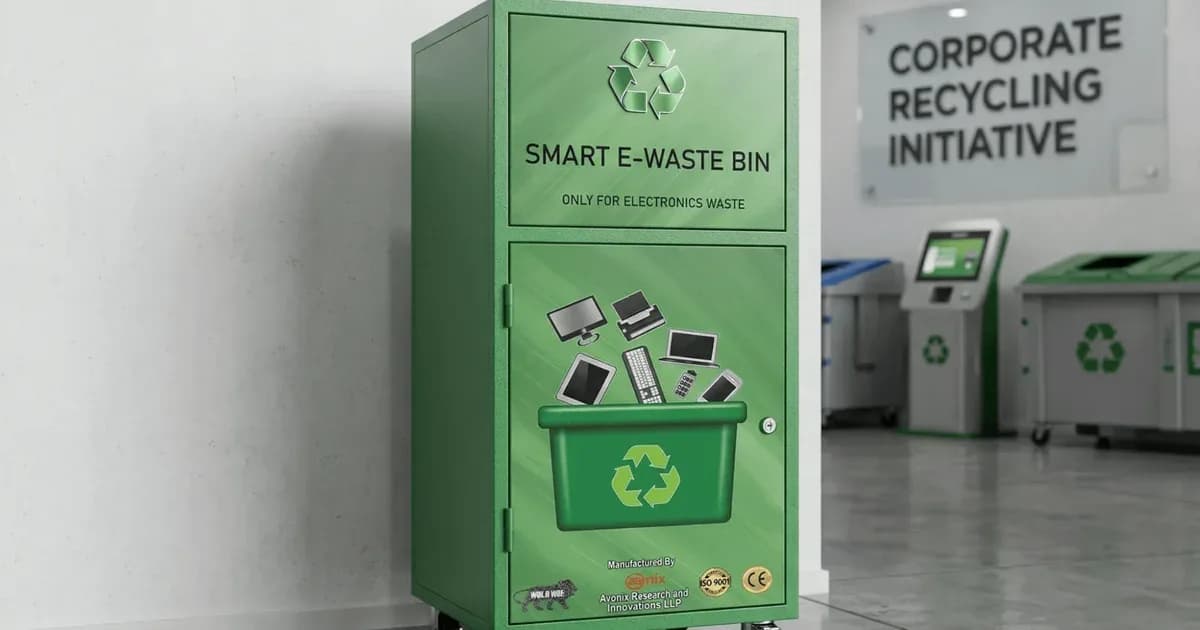
- A separate waste stream such as electronics: you need a dedicated collection bin with fill alerts, like an e-waste bin, rather than a compactor.
1. Compaction: how much capacity it really adds
A compactor bin presses waste down with a motorised plate, so a small footprint holds far more. Ask for the volume reduction and the effective capacity in litres, not just the shell size. Our compactor bin reduces volume by 65–70%, which gives its 125-litre shell up to five times the capacity: the equivalent of about 625 litres uncompacted.
Ask what the compactor is built for. Compaction suits dry municipal waste such as paper, plastic and packaging; it is not meant for liquids, glass or hazardous waste. Then ask how the mechanism protects itself. An underpowered motor jams and an overpowered one wears itself out, so look for jam detection, a controlled retract and overload protection, and, because compacted waste can heat up, fire detection.
2. Power: solar that survives Indian conditions
Running grid power to every bin means trenching, permits and a monthly bill, so most outdoor smart bins run on solar. Check three numbers: panel size, battery capacity and hours of backup without sun. Our bin uses a 60 W panel and a 28 Ah battery, charges in 5–6 hours of direct sun and runs for up to 36 hours without sunlight.
Spec sheets assume clean panels and mild weather. In India, dust cuts generation by 5–15% a month, monsoon weeks deliver almost nothing, and batteries rated in a lab fail in 45°C summers. Ask how the supplier sized the panel and battery for those conditions, and what happens when the battery does run out: there should be a manual override so the bin can still be opened.
3. Fill-level sensing you can trust
The point of a connected bin is to send collection only when it is full, and that only works if the fill reading is right. In a compactor, the same waste reads differently before and after compaction, so the sensing has to account for the compaction state. Ask which sensor is used (our compactor bin uses LiDAR) and how it is calibrated. A dashboard that shows the wrong fill level is worse than no dashboard.
4. Connectivity and the dashboard
A bin that senses but cannot report is just a bin. Check how it connects. GSM works wherever there is mobile coverage and does not depend on local Wi-Fi, which matters on streets and station platforms.
Then look at the software, which is half the product: live fill levels for every bin, collection history, fault alerts, route planning, and alerts such as SMS to the staff who empty the bins. Ask whether the dashboard is included and for how long. For our compactor bin with the GSM or Wi-Fi module, the dashboard is included for the first year.
5. Built for the street: weather and vandalism
- Enclosure: look for an IP65 rating or better for outdoor sites.
- Electronics: conformal-coated circuit boards cope with humidity and dust far better than bare boards.
- Temperature: check the operating range; ours is rated from -40°C to 85°C.
- Tamper protection: the solar panel and battery are the first targets, so look for anti-theft mounts, tamper-evident fixings and alerts on unexpected access.
- Hygiene: a hands-free, sensor-operated opening means people never touch the bin.
6. Maintenance, warranty and service
Ask what routine maintenance the bin needs and who does it. Ours needs a battery check every six months and sensor cleaning once a month. Check the warranty (ours is one year as standard, with extended AMC available) and whether the supplier can service bins locally rather than shipping parts from abroad.
7. Why buying from an Indian manufacturer helps
A supplier that designs its own circuit boards and firmware can adapt the bin to a tender's requirements and fix problems in the field instead of waiting on an importer. Our compactor bin and e-waste bin are designed and built in Kolkata, and the e-waste bin is deployed for the West Bengal Pollution Control Board.
A quick checklist
- Compaction ratio and effective capacity in litres
- Solar panel, battery and hours of backup without sun
- Fill sensor type and how it handles compacted waste
- GSM or Wi-Fi, and what the dashboard shows
- IP rating, coated electronics and tamper protection
- Maintenance schedule, warranty and AMC
- Who designs, builds and services the bin
Pricing
Smart bin prices depend on the configuration (compaction, solar, connectivity, wheels) and on quantity, so suppliers quote per project. Tell us how many bins you need and where they will stand, and we will recommend a configuration and send you a quote.
See the Solar Smart Compactor Bin →