
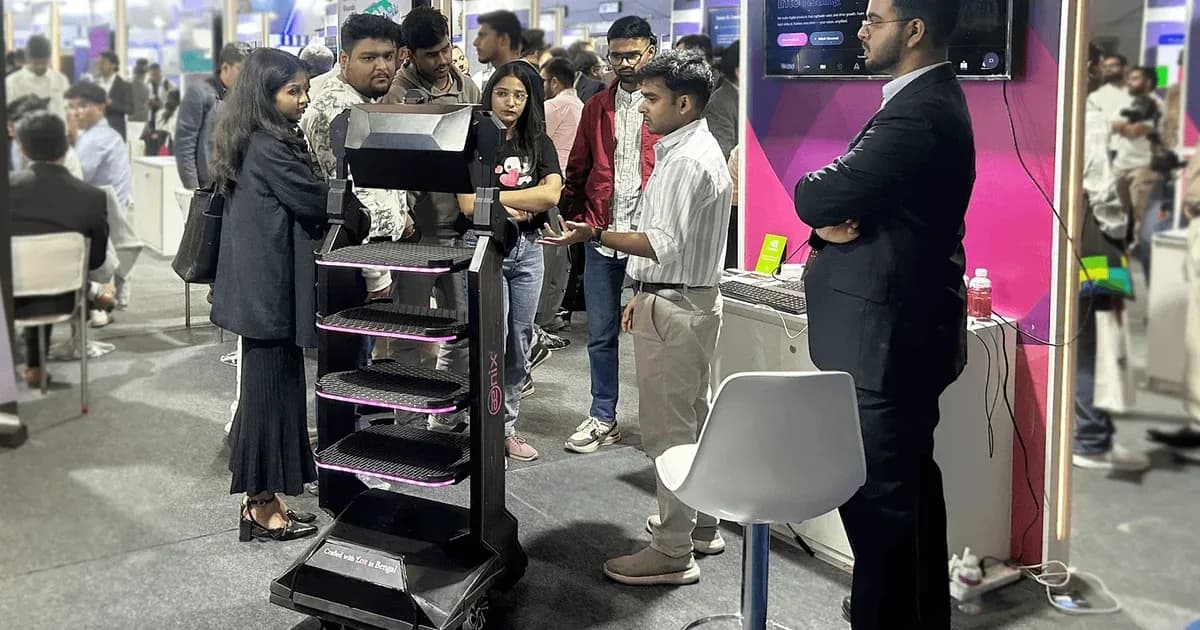
A restaurant service robot carries orders from the kitchen or loading station to the table, finds its own way through the dining room and comes back for the next run. Many serving robots sold in India are imported: designed for other venues and supported from far away. This guide covers what to check before you buy one, drawn from building and running Misti, the autonomous serving robot we design and build in Kolkata.
What a serving robot actually does
- Load: staff place the order on the robot at the loading station and send it to a table.
- Navigate: the robot drives to the table on its own, avoiding guests and obstacles along the way.
- Serve: the guest takes their order from the robot.
- Return: the robot goes back to the loading station, ready for the next order.
It does not replace your staff. It takes the walking off them, so they spend more time with guests and less time carrying plates.
1. How does it find its way?
There are three common approaches. Line-following robots follow a marked path on the floor, which is simple but means changing the venue. App-controlled robots are driven by a person. The robots that need no venue changes use LiDAR-based SLAM: the robot maps the room once, then plans its own routes to predefined tables. Misti uses LiDAR SLAM and also supports line-follower and app-based control where a venue needs them.
2. What happens when someone steps in front of it?
A dining room is full of moving people, children and chairs pushed back from tables. Ask how many sensors watch the path, whether the robot steers around obstacles or only stops, and whether there are both physical and software emergency stops. Speed matters too: in crowded event spaces our robot moves at 0.3–0.5 m/s, slower than walking pace.
3. Can it carry a full load without wobbling?
Check the number of trays, the load per tray and how the robot stays stable at full payload, especially over thresholds and uneven tiles. Misti 2.0 is 150 cm tall, has four trays that carry up to 10 kg each, and rides on two large drive wheels with four omnidirectional castors so it stays steady when fully loaded.
4. Does it speak your guests' language?
For Indian venues, check whether the voice can be set up in Hindi, Bengali or other Indian languages, and whether it can answer guests' questions, not just play recorded lines. Misti speaks English and Hindi as standard, with more languages on request, and at events it answers questions about the agenda and venue from the organiser's own information.
5. Can your staff use it without training?
The robot is only useful if the floor team trusts it on a busy night. Look for a simple touch interface for sending orders and confirming delivery, multi-table delivery so one run serves several tables, and a clear way to bring the robot back if a plan changes.
6. Who supports it after installation?
This is where imported robots most often disappoint. When a sensor fails or a map needs updating, you need engineers who can respond in days. Ask where support comes from, whether the robot can be monitored and updated remotely, and whether on-site support is included. Misti connects over Wi-Fi with cloud sync for remote monitoring and updates, and our own team in Kolkata handles ordering, deployment and on-site support.
7. Can it be customised for your venue and brand?
Hotels, restaurant chains and event organisers often want the robot to carry their own look, voice and screens. Because we build Misti's body, electronics, firmware, AI and navigation in-house, its hardware, software, voice language and design can all be tailored. Misti 2.0 also has a second large display for branding, schedules and QR codes.
Restaurants, hotels and events
A restaurant with a fixed layout can run the robot autonomously on mapped routes all day. Events are different: stands go up and crowds build by the hour, so the robot needs an operator mode. At events, an Aeonix operator drives Misti in real time where the floor keeps changing, and a two-person crew stays with it from set-up to close. At the Inc42 CTO Summit at the JW Marriott, Bengaluru, on 30 September 2026, Misti 2.0 served more than 175 CTOs and VPs of Engineering. It has also appeared at the India AI Impact Summit in New Delhi and TCS Family Day.
Where serving robots fit
- Restaurants
- Hotels
- Corporate dining and offices
- Conferences, summits and corporate events
- Experience centres, showrooms and museums
- Hospitals, airports and banks, for guiding and delivering
A checklist before you buy
- Does it need floor markings or other changes to the venue?
- How does it detect and avoid people, and how fast does it move?
- How many trays, and what load per tray at full stability?
- Which languages can it speak, and can it answer questions?
- Can staff send it to several tables in one run?
- Who repairs it, how quickly, and is remote monitoring included?
- Can the body, screens and voice carry your brand?
- Can you see it working in a real venue before you commit?
Misti: restaurant service robot, made in India →
Case study: Misti 2.0 at events and in hospitality →