
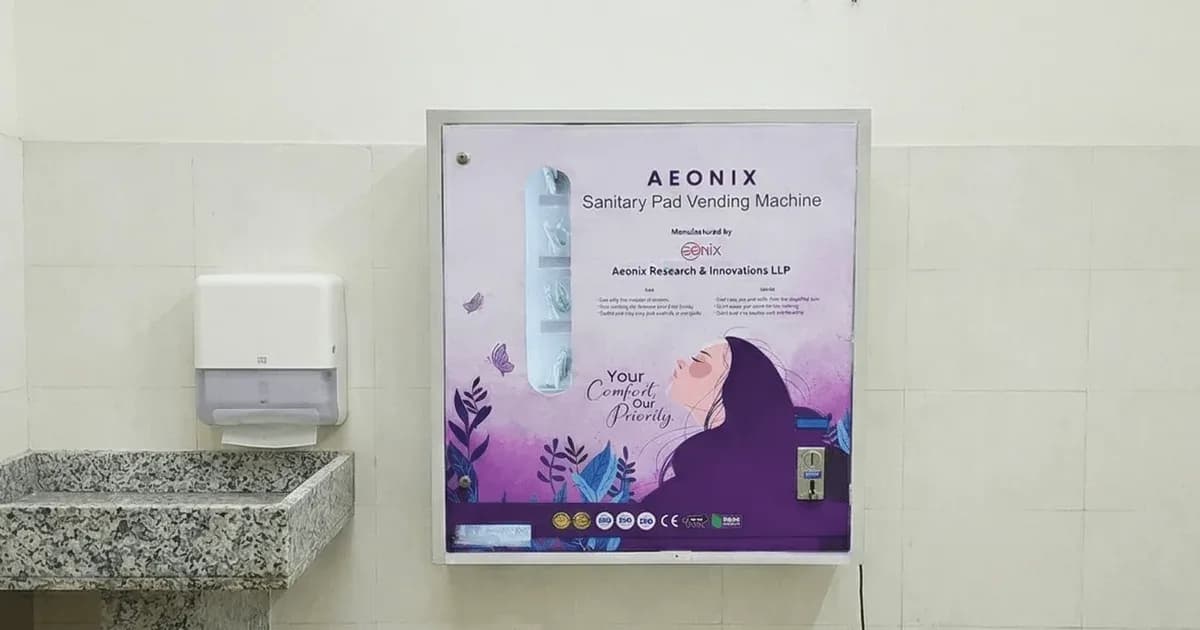
A sanitary pad vending machine puts a napkin within reach at the moment it is needed: in a school washroom, a college hostel, an office or a railway station toilet. Choosing one is less about the box on the wall and more about how it will be run: who pays, who refills it, and who finds out when it is empty. This guide covers what to check, drawn from the sanitary pad vending machines we design and build in Kolkata and run in government schools and public institutions, where the hygiene programmes they support have reached more than 50,000 girls.
1. Free, token or paid dispensing?
Decide this first, because it changes everything else. A school hygiene programme or a CSR project usually wants free dispensing. A hostel or factory may hand out tokens. A public washroom or railway station may charge per napkin to keep the machine stocked. A good machine supports all three, so the same unit can move between programmes. Ours can be set up for free, token-based or paid dispensing.
2. Coin and UPI
Where dispensing is paid, accept both cash and digital payment. Many users carry only coins; many carry only a phone. Our machine takes 1, 2, 5 and 10 rupee coins and UPI apps such as Google Pay and PhonePe, and it returns the coin automatically if it is out of stock or the power fails, so nobody loses money to an empty machine.
3. Capacity, refills and stock alerts
An empty machine is worse than no machine: users stop trusting it. Check how many napkins it holds, how long a refill takes and how staff learn that stock is low. Our machine holds up to 100 napkins, refills in under two minutes through a key-locked compartment, and sends a stock alert to designated staff when it falls below a set level, so one person can look after several machines in a single round.
4. Reliable, discreet dispensing
- Sensor-based detection, so each transaction gives exactly one napkin, with no jams and no double dispensing.
- A privacy-shielded collection slot, so the napkin can be collected discreetly.
- A simple selection process that takes seconds, with a display that shows when stock has run out.
- Battery backup, so a short power cut does not stop the machine.
5. Installation and size
Most washrooms have little floor space, so a wall-mounted machine is usually best. Ours is 74.5 cm wide, 49 cm high and 18.5 cm deep, weighs about 6.7 kg, and mounts on the wall at eye level. It runs on standard 230 V AC mains and draws 60 W. The body is 1–1.2 mm mild steel with a powder coat.
6. Disposal
Giving girls and women napkins without a safe way to dispose of used ones only moves the problem. In schools and institutions, plan for disposal at the same time as dispensing. Our sanitary pad vending machines in government schools and institutions are installed with incinerators.
7. Data for the people running the programme
For a programme across many schools or offices, the dashboard matters as much as the machine. Every one of our machines reports stock, sales and device status to a central web dashboard, so administrators can see usage by location, prove the programme is working and send refills only where they are needed.
8. Support and warranty
Ask who installs the machines, who repairs them, and how quickly. Our machines come with a one-year standard warranty and are installed and supported by our own team in Kolkata, and supplied across West Bengal and the rest of India.
Where they are used
- Schools, colleges, universities and hostels
- Hospitals and health clinics
- Corporate offices, factories and industrial units
- Railway stations, bus terminals, airports and shopping malls
- Public toilets, community centres and government office complexes
- NGO and CSR programmes
A checklist before you buy
- Can it run free, token-based and paid dispensing?
- Does it take both coins and UPI, and return coins when it cannot dispense?
- How many napkins does it hold, and how long does a refill take?
- Who is alerted when stock runs low, and how?
- Is there a dashboard showing usage by location?
- How will used napkins be disposed of?
- What warranty comes with it, and who provides support near you?
Sanitary pad vending machine and incinerator, made in India →
All our IoT vending machines →
Access to menstrual hygiene is not a privilege. It is a necessity. →