
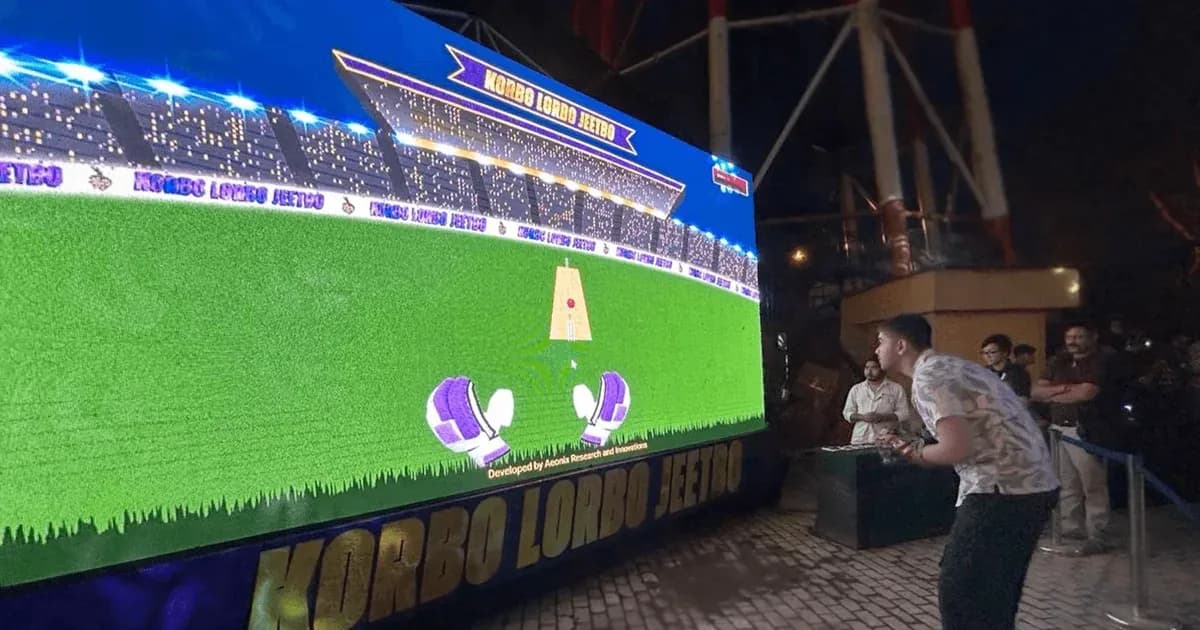
Users walk up. They wave their hands. The game responds. No buttons, no touchscreens, no calibration.
The hard part wasn't the game. It was the latency budget.
Humans notice input lag above ~100ms. Above 150ms it feels broken. We had a stadium full of people, variable lighting, no time for any user to "learn" the system, and every interaction had to feel instant.
Here's the architecture call that made it work:
No cloud: everything on edge GPU
A round-trip to AWS or any cloud inference service is 80-200ms on a good day in India. That's the entire budget gone before our model even runs. We put a GPU at every station. Total inference latency: under 40ms.
Custom models, not Mediapipe
Off-the-shelf gesture libraries assume controlled lighting. Stadiums don't have that. LED billboards strobing, sun moving across the stand, shadow patterns from the structure overhead. We trained models on footage that looked like the actual venue, not a clean studio.
60+ FPS capture, frame skipping budgeted
The pipeline runs at high FPS but the model doesn't process every frame — it can't, and it doesn't need to. Smart frame selection based on motion delta. Idle frames get dropped, action frames get prioritized. CPU usage stays sane, GPU stays cool.
Pre-processing in C, not Python
Image normalization, ROI extraction, and tensor prep happen in compiled code paths. Python's fine for training. It's not fine when you're chasing 40ms end-to-end.
What broke during testing
- Color casting from stadium LEDs threw off the first model entirely. Retrained with augmented color shift data.
- One station overheated within 2 hours of continuous play. Added forced airflow before deployment.
- Multiple users in frame confused early versions of the tracker. We added skeletal disambiguation logic.
The instinct most engineers have today is to wrap an LLM or a cloud API and call it AI. That doesn't work when latency is non-negotiable, conditions are messy, and you can't afford a single bad demo in front of tens of thousands of people.
Real-time CV at venue scale is its own engineering discipline. There's no API for it.
Build for the latency budget, not the demo.
If you're working on real-time vision systems for live environments — happy to swap notes.
Case study: real-time gesture gaming for IPL and live events →
Our AI and computer vision work →
Originally published on LinkedIn. Read the comments there →