
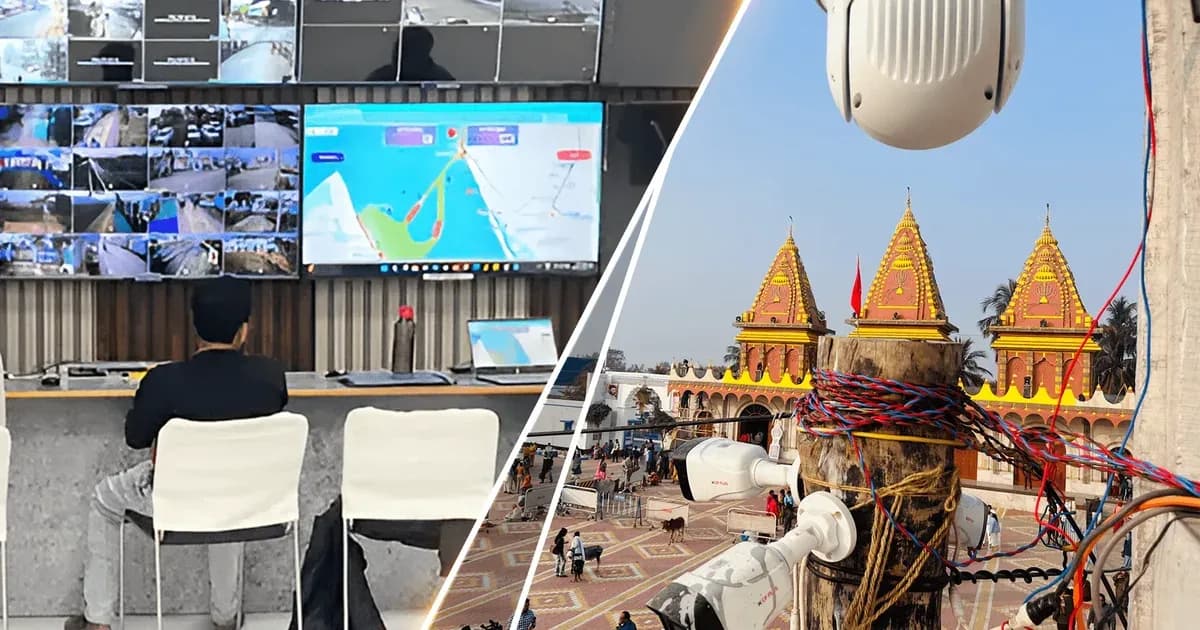
Tens of millions of pilgrims. Days of nonstop crowd. A tidal sandbar with no shade, no clean walkways, and patchy 4G that disappeared whenever it mattered most.
The brief was simple: detect sanitation issues in real-time, alert cleaning crews, do it without depending on the internet.
That last part broke most of our standard playbook.
No cloud APIs. No "send the frame to AWS." No GPT-4V. Anything that needed a round-trip to a server was going to fail.
Everything had to run locally. On-device. On GPU at the edge.
Which meant four things.
Custom models, in-house
Off-the-shelf models broke on fog, dust, and human density. We trained on data that looked like the actual ground.
Quantized for edge GPUs
Cloud-grade models are too heavy for Jetson-class hardware. Weeks of optimization. Model size down ~70%, accuracy held.
Local first, sync later
Detections processed locally. Dashboard synced when network came back. 3-hour blackout? System still worked.
Thermal engineering bit us on Day 1
Edge GPUs in metal boxes under direct sun started throttling within hours. We were retrofitting cooling in the field.
By Day 2, the dashboard was lighting up with real detections. Field teams were responding faster as routing logic learned where crews actually moved.
What it taught us
- The cloud-first reflex is dangerous. Real environments don't always have the network you assume.
- Edge AI is a real engineering discipline — model optimization, thermal design, local resilience.
- The hardest part of AI in India isn't the AI. It's everything around it.
Deployments at this scale teach you things no lab can.
If you're building AI/CV that has to work in disconnected, harsh environments — happy to swap notes.
Case study: AI sanitation monitoring at Gangasagar Mela →
Our AI and computer vision work →
Originally published on LinkedIn. Read the comments there →